
QXD MedTech · Shanghai
Self‑evolving Life Operators, toward full‑scale life simulation.
We build Life Operators — a unified computational framework that models, simulates and updates the dynamics of life across scales: cell, tissue, organ, patient.
Life is computable. Medicine, super‑evolved.
01 · Vision
Medicine’s next leap is from AGI to ASI.
The step change in medical intelligence is not better recognition or better answers — it is the ability to perceive, model and simulate the processes of life itself.
Narrow medical intelligence
Single-point perception tools.
- Lung-nodule detection
- Fundus image diagnosis
General medical intelligence
Understanding and autonomous reasoning.
- AI consultation
- Agentic doctors
Super medical intelligence
Life simulation, across every scale.
- Treat disease before it arrives
- One person, one medicine
“Medicine will no longer be content to see disease that has already happened — it will simulate the living system, and rehearse the trajectory of disease before it truly arrives.”Junbo Ge · Academician, Chinese Academy of Sciences · Cardiology
“With data and AI we are, in essence, building a virtual twin of the patient. When the model is reliable enough, we can simulate the effect of a drug — alone or in combination.”Olivier Elemento · Englander Institute for Precision Medicine, Weill Cornell
“Map every patient to a digital twin in the cloud, and you can run safe simulations on the patient’s own data before touching the real treatment system.”Boris Kovatchev · Founding Director, UVA Center for Diabetes Technology
02 · The gap
Prediction is not simulation.
Today’s frontier — Delphi‑2M, ALADYNOULLI, Oncoformer — learns the statistics of clinical records. Impressive, and far from life simulation: statistical sequence models see the chart, not the cross‑scale dynamics of the living system that produced it.
Sequence prediction
What happens next
- Learns token statistics from medical records
- Forecasts risk, prognosis, next event
- Cannot say why — or what an intervention changes
Life simulation
Why it happens — and what changes after intervention
- Models latent life state across molecule, cell, tissue, organ, body
- Evolves that state under natural dynamics and treatment
- Closes the loop against new observations
03 · Framework
One framework, every scale of life.
Molecular dynamics, virtual cells, virtual tissue, organ and patient digital twins each live at their own point in space and time. The Life Operator is the single mathematical object that connects them.
Mechanistic laws
PDE · ODE · reduced-order models
Data-driven laws
Flow matching · Koopman · neural operators
Sequential update
Bayesian filtering · smoothing

One framework across temporal and spatial scales.
04 · The science
Life as a dynamical system.
Multimodal observations infer a latent life state; operator dynamics evolve it — under aging, disease and treatment — and generate the observable signals of the future.
Observations
Y≤t, U<t, C≤t
Imaging · signals · omics · pathology · wearables · labs
Latent life state
Zt
Cell · tissue · organ · whole-body state
Dynamics
Żt = f (Zt, Ut, Ct)
Aging · disease onset · intervention · recovery
Future trajectory
Yt+Δt ~ p(·|Zt+Δt)
Signals and phenotypes, forward in time
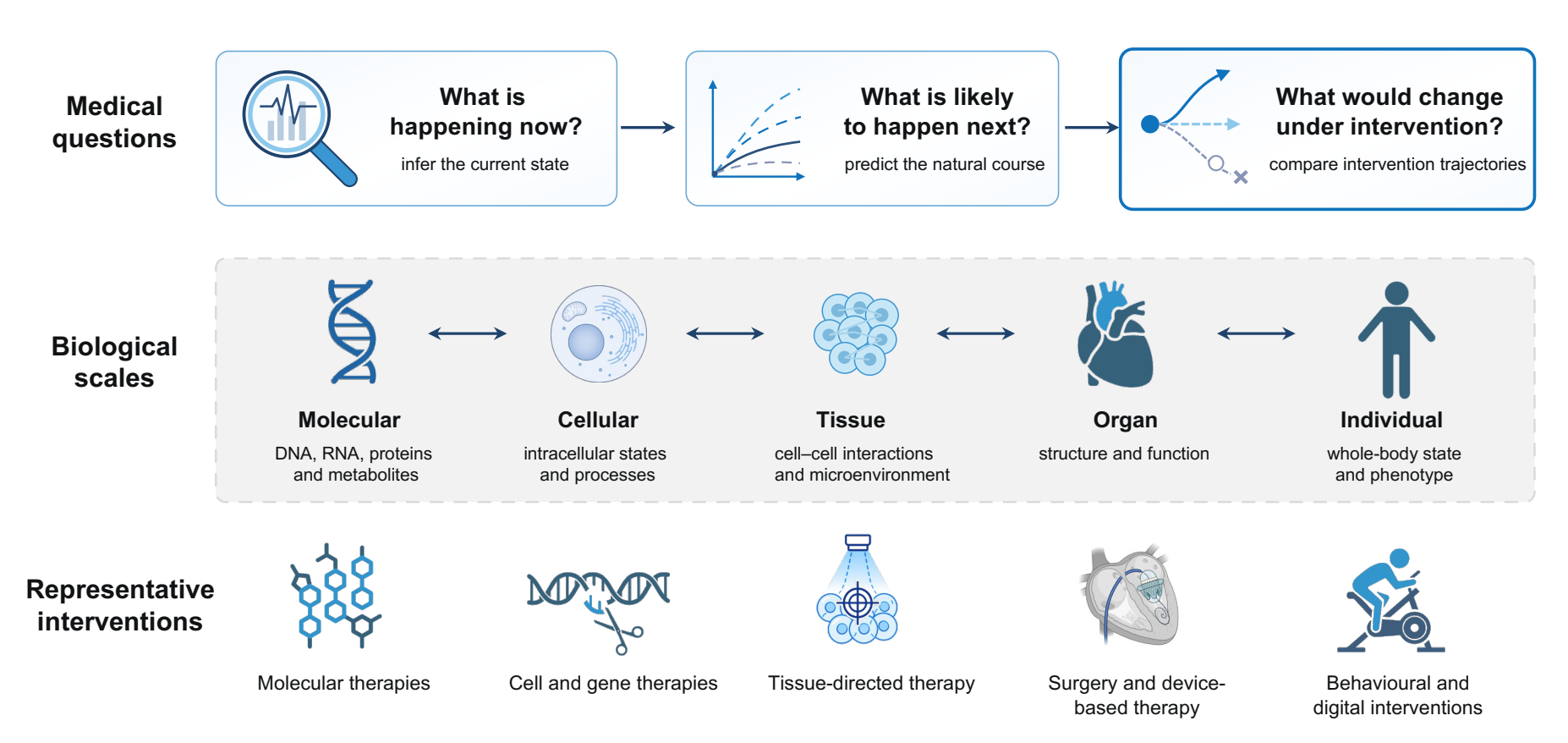
Three questions of medicine — the current state, the natural course, and what changes under intervention — asked at every biological scale.
05 · Self-evolution
Operators that improve themselves.
AI4AI: agentic Auto‑Research replaces linear R&D, and a real‑world data flywheel keeps every operator evolving after deployment.
Auto-Research
One scientist, 100× agents
Literature, data, hypothesis, operator-design and validation agents discover, build, verify and upgrade Life Operators — recursively — from large-scale historical data.
- Hypothesis generation → data organization
- Operator optimization → validation → composition → upgrade
Data flywheel
Real-world feedback, closed loop
Every delivered project returns data to the operator system: governance → design → training & simulation → validated delivery → real-world use → data return.
- Harder operators, broader capability
- Faster feedback, fuller system
06 · Evidence
Warm‑started with clinical‑scale proof.
Life Operators are not starting cold. Disease-specific programs in renal cancer and cardiology have already closed the loop from data to model to validation.
Renal program
RenalCLIP — a disease-specific foundation model
Outperforms radiomics, clinical scoring and general CT foundation models; surpasses specialist urological radiologists on small renal-mass differentiation.
Cardiac program
A data–solver–simulation loop for the heart
Million-scale multimodal cardiac data, neural-operator solvers, aging trajectories reproduced across three cohorts, and commissioned virtual clinical trials validated against Phase I results.
07 · Applications
Simulation opens new ground for medicine.
Drug R&D
- Clinical-trial design
- Indication & population selection
- Efficacy probability & extrapolation boundaries
Device R&D
- Structure–function–intervention simulation
- Plan comparison & virtual validation
- Risk-boundary definition
Treatment decisions
- Patient-state reconstruction
- Intervention comparison & MDT support
- Disease-course simulation
Health management
- Risk trajectories & follow-up cadence
- Intervention advice & long-term tracking
- Natural-aging simulation
08 · The system
One computation graph, from cells to the whole body.
Every scale of life carries its own latent state. Life Operators couple those states — represent, evolve, generate, update — into a single whole‑body computation graph that simulates the future.
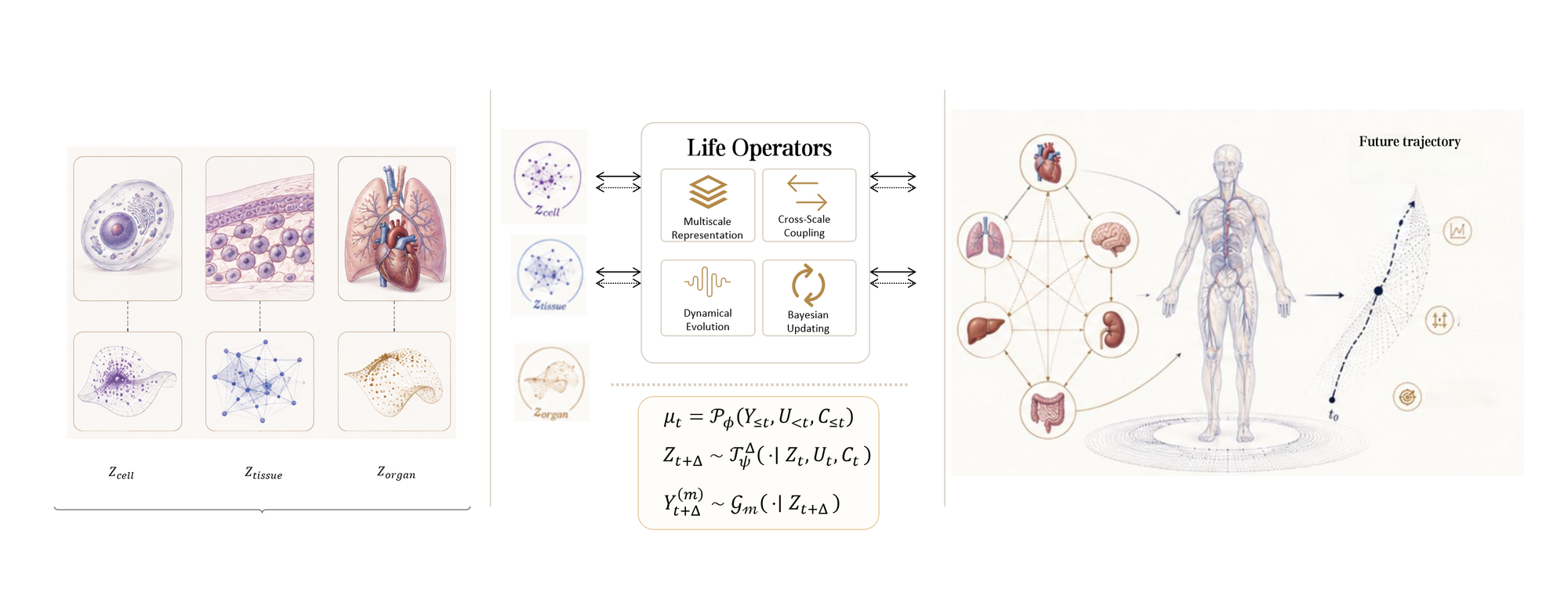
Latent life states
Cell, tissue and organ each hold their own latent space — Zcell, Ztissue, Zorgan — with its own representation and dynamics.
Operator primitives
Multiscale representation, cross-scale coupling, dynamical evolution and Bayesian updating — composed as perception, transformation and generation operators.
Whole-body simulation
Coupled organs form the full-scale computation graph: from state t0, simulate the future trajectory — risk, intervention, outcome.
Next milestone
Cardio‑World — the full‑scale cardiac simulation model
The heart is where multi-scale simulation breaks through first: clear clinical demand, million-scale data, well-understood physics, and a short path to validation. Cell electrophysiology, tissue conduction and organ hemodynamics, coupled up‑scale and inverse.
09 · Founder
Fifteen years on one question: how to compute life.
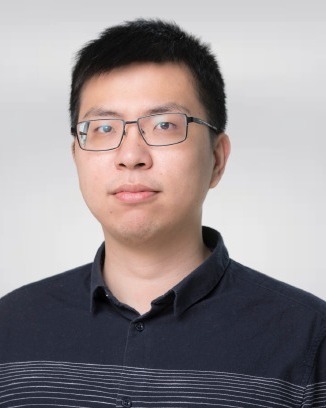
Wang Shuo — founder & CEO. PI of the multimodal medical AI group at Fudan University; trained in mechanics at Fudan and in medical imaging at Cambridge; author of representative work in Nature Biomedical Engineering, Nature Machine Intelligence, Nature Medicine and Nature Communications.